Key Takeaways
- The biohacking movement originated in the early years of the 21st century with DIY makers inserting magnets and RFID chips into their bodies.
- Neuralink plans to manufacture 1000 advanced brain chips by the year 2026.
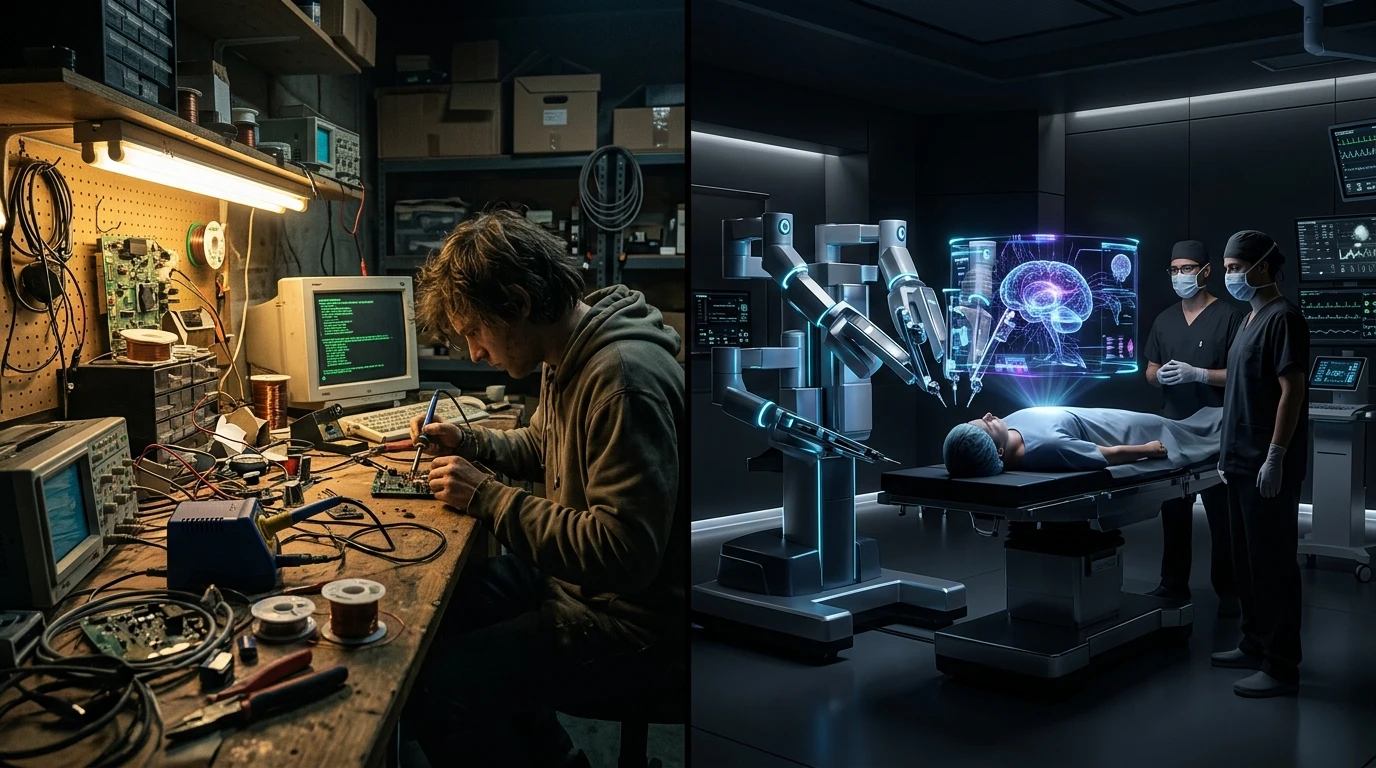
- The industry has transitioned from unregulated garage laboratories to highly controlled, robotic neurosurgery overseen by the Food and Drug Administration.
The Grinder Genesis: Garage Labs and Magnets
As an analyst who has tracked DIY maker movements for over 15 years, the evolution of human augmentation is a fascinating case study in grassroots innovation. Before the era of billion-dollar medical tech valuations, a radical subculture known as “grinders” emerged. These early biohackers did not wait for clinical device corporations to catch up to their cyberpunk visions. Instead, they utilized sterilized piercing needles and dermal punches in basement workshops to implant neodymium magnets and basic RFID chips into their fingertips and hands.
The methodical goal was sensory expansion. A magnetic implant allowed a maker to literally feel electromagnetic fields from microwaves, power transformers, and spinning hard drives. It was a crude but highly effective method of extending the human nervous system. However, the procedures carried significant risks, from severe infections to implant rejection, highlighting the extreme lengths to which early pioneers would go to transcend biological limitations.
Tools of the Early Trade
The standard toolkit of an early biohacker closely resembled a mixture of a tattoo parlor and a hobbyist electronics bench. Glass-encased RFID tags, similar to those used in veterinary medicine, were repurposed to unlock doors or store small kilobyte files. The structured, experimental nature of these DIY enthusiasts paved the way for more systematic scientific inquiries, much like how the history and evolution of photobiomodulation in ophthalmology started with basic light experiments before becoming a refined clinical therapy.
The Shift to Clinical Precision
The transition from underground body modification to highly regulated biotechnology did not happen overnight. As the theoretical possibilities of brain-computer interfaces expanded, the required engineering precision outgrew the capabilities of any DIY garage lab. We are now witnessing a paradigm shift led by well-funded entities like Neuralink, founded by Elon Musk.
What once required a brave volunteer and a scalpel now involves highly advanced robotic systems. The Food and Drug Administration has stepped in to rigorously regulate these procedures, ensuring that the integration of artificial intelligence into the human brain meets stringent safety standards.
Neuralink and the Year 2026
The data points surrounding modern neurosurgery are staggering. As Neuralink prepares to mass-produce 1000 brain chips in the year 2026, the contrast with early biohacking is stark. These modern implants feature thousands of microscopic electrodes, inserted by a surgical robot with a level of precision that no human hand could ever achieve. The objective has shifted from feeling magnetic fields to restoring motor functions in paralyzed individuals and seamlessly interfacing with vast data networks.
What This Means for the DIY Maker Community
For the modern hobbyist, the leap from a fingertip magnet to an artificial intelligence brain chip might seem like the end of grassroots biohacking. However, the core ethos remains intact. The relentless human drive to experiment, understand, and improve our biological hardware continues to inspire new generations of makers. While we may leave neurosurgery to the clinical robots, the foundational mindset of the grinder movement—questioning limits and engineering solutions—will forever remain the beating heart of the DIY community.